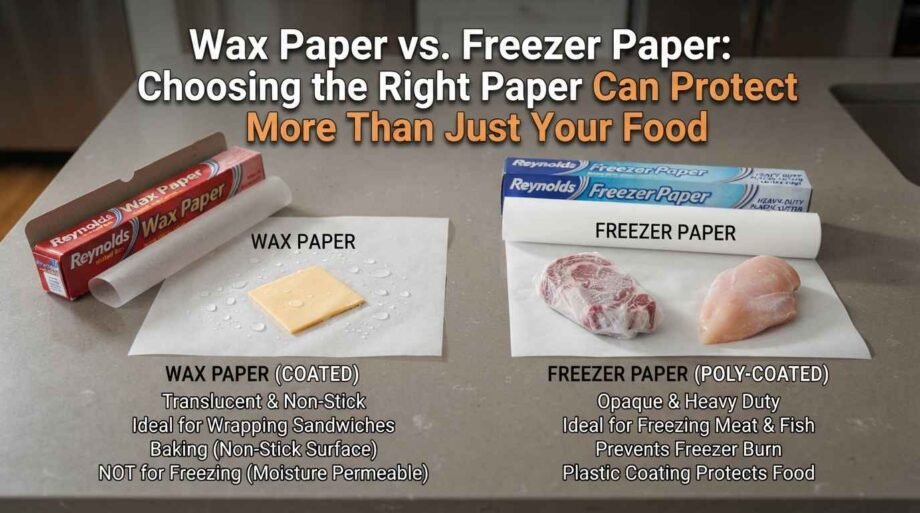
Every year, thousands of pounds of food are wasted because of improper storage. While temperature plays a major role in preserving freshness, the packaging material wrapped around food is equally important. A steak stored for six months, homemade cookie dough prepared for later use, or a sandwich packed for lunch all have one thing in common—they depend on the right wrapping material to maintain quality.
This is where confusion often begins.
Many people believe wax paper and freezer paper are interchangeable because they share a similar appearance. Both are made from paper, both are used in kitchens, and both are associated with food storage. Yet beneath their similar appearance lies a completely different purpose. One is designed to simplify everyday food preparation and presentation, while the other is engineered to protect food during extended periods of frozen storage.
Using the wrong paper may not seem like a serious mistake, but it can affect texture, flavor, moisture retention, storage life, and packaging costs. A restaurant wrapping freshly prepared burgers has very different packaging requirements than a butcher preserving premium beef cuts for months in a freezer. Likewise, a bakery packaging cookies has different priorities than a meal-prep company organizing hundreds of frozen meals.
Understanding these differences helps consumers make better decisions at home while allowing businesses to choose packaging that improves efficiency, reduces waste, and protects product quality.
In this guide, we’ll explore how wax paper and freezer paper are made, how they perform under different storage conditions, where each material excels, and which option is best for specific foods and industries.
Why Do People Confuse Wax Paper and Freezer Paper?
The confusion is understandable. At first glance, both products seem almost identical. They are flexible, lightweight, available in rolls or sheets, and commonly sold alongside other food wrapping materials. Without looking closely, many shoppers assume they perform the same job.
However, appearance tells only part of the story.
The real difference lies in the way each paper is engineered. Manufacturers designed wax paper to solve one set of packaging challenges and freezer paper to solve another. Their coatings, strength, moisture barriers, and intended applications are all different.
Think of them as two tools in the same toolbox. A screwdriver and a wrench may sit beside each other, but each is designed for a different task. Food wrapping papers work in much the same way.
Choosing between them should never be based on appearance alone. Instead, it should depend on how long the food will be stored, whether grease or moisture is the main concern, and what level of protection is required.
Looking Beneath the Surface: How These Papers Are Made
The performance of any packaging material begins long before it reaches the kitchen. The manufacturing process determines how the paper reacts to grease, moisture, freezing temperatures, and everyday handling.
Although both products start with a paper base, the similarities largely end there.
Wax Paper: Built for Everyday Food Handling
Wax paper begins with a lightweight paper substrate that is coated with a thin layer of food-grade wax. Depending on the intended application, the coating may be applied to one side or both sides.
This wax layer serves several purposes at once. It creates a smooth surface that prevents many foods from sticking, blocks grease from soaking through the paper, and provides a light barrier against moisture. The result is a wrapping material that is easy to fold, comfortable to handle, and ideal for ready-to-eat foods.
One of its greatest strengths is flexibility. Wax paper wraps neatly around sandwiches, pastries, cookies, and burgers without adding unnecessary bulk. It also provides an excellent surface for custom printing, making it popular with restaurants, cafés, bakeries, and food brands that want to combine food protection with attractive branding.
Rather than acting as a heavy-duty storage material, wax paper is designed to simplify everyday food handling while maintaining freshness during short-term storage.
Freezer Paper: Engineered for Long-Term Protection
Freezer paper follows a different design philosophy.
Instead of focusing on presentation or convenience, it is built to protect food against one of frozen storage’s biggest challenges—moisture loss.
A sheet of freezer paper typically consists of a heavier paper base with a protective coating applied to one side. When wrapped correctly, the coated side faces the food, helping reduce the transfer of moisture between the product and the surrounding air inside the freezer.
This additional protection is particularly important when storing meat, poultry, seafood, or prepared meals for extended periods. Without a sufficient barrier, frozen food gradually loses moisture, leading to dry surfaces, texture changes, and the condition commonly known as freezer burn.
The thicker construction also makes freezer paper more resistant to tearing when wrapping heavier products such as bone-in cuts, whole poultry, or large portions of fish.
For businesses that rely on frozen inventory, this added durability helps preserve both product quality and customer satisfaction.
The Science Behind Food Protection
To understand why these papers perform differently, it helps to look at the three main factors that influence food storage:
- Grease
- Moisture
- Air
Each material is designed to manage these elements in its own way.
Managing Grease
Grease is one of the biggest challenges in food packaging. Oils can quickly penetrate ordinary paper, leaving wrappers messy and reducing their strength.
Wax paper addresses this problem through its wax coating. The coating slows the movement of oils, helping maintain a clean exterior while improving the customer’s handling experience.
This is one reason burger wrappers, pastry papers, and sandwich wraps are often made from wax paper.
Freezer paper can also resist grease to some extent, but grease management is not its primary function.
Controlling Moisture
Moisture affects food differently depending on the storage environment.
Fresh foods benefit from packaging that limits excess moisture transfer while still protecting the product during transportation and handling.
Frozen foods, however, face a different challenge. Inside a freezer, moisture naturally migrates away from food over time. If the packaging cannot slow this process, surfaces become dry and quality gradually declines.
Because freezer paper is specifically engineered to reduce moisture loss during frozen storage, it offers a significant advantage for long-term preservation.
Limiting Air Exposure
Air exposure contributes to changes in flavor, texture, and appearance.
Neither wax paper nor freezer paper creates a completely airtight seal on its own. However, freezer paper provides a more suitable protective layer for frozen products when wrapped securely.
Many commercial food processors combine freezer paper with additional packaging methods to maximize product shelf life.
Different Papers for Different Packaging Goals
One of the biggest misconceptions in food packaging is the belief that every wrapping paper should perform every task equally well.
In reality, packaging materials are designed around specific priorities.
Wax paper prioritizes:
- Easy handling
- Attractive presentation
- Grease resistance
- Non-stick performance
- Efficient food service
- Brand printing
Freezer paper prioritizes:
- Frozen food preservation
- Moisture retention
- Long-term storage
- Tear resistance
- Meat protection
- Inventory organization
Neither approach is inherently better—they simply solve different packaging challenges.
A café serving hundreds of sandwiches each day gains little benefit from freezer paper, while a butcher storing premium steaks for several months would not rely on wax paper alone.
Selecting the correct material means understanding the environment in which the food will be stored and the level of protection it requires.
A Quick Reality Check
Imagine placing two identical pieces of fresh salmon into a freezer.
One is wrapped in wax paper before freezing.
The other is carefully wrapped with freezer paper, coated side against the fish, and sealed properly.
After several months, the difference is likely to become noticeable. The fish protected with freezer paper is generally better equipped to retain moisture and maintain quality, while the piece wrapped only in wax paper may be more vulnerable to surface dehydration over extended storage.
Now imagine a completely different situation.
A bakery prepares hundreds of fresh cookies every morning. These cookies are sold the same day and need attractive wrapping that prevents butter from soaking through the paper while displaying the bakery’s branding.
In this case, freezer paper would provide little additional value. Wax paper delivers the grease resistance, flexibility, and presentation quality the bakery actually needs.
These examples highlight an important lesson:
The best packaging material isn’t the one with the most features—it’s the one designed for the specific job.
When Performance Matters: Putting Both Papers to the Test
Reading product descriptions is one thing, but understanding how a material performs in real-world situations is what truly helps you make the right choice. A food wrapper that works perfectly for a fresh sandwich may fail when protecting frozen meat for several months. Likewise, a paper designed for freezer storage may add unnecessary cost to products that are sold within hours.
Rather than asking, “Which paper is better?”, a more useful question is:
“Which paper performs better for my specific application?”
Let’s compare wax paper and freezer paper across the situations where businesses and consumers use them every day.
Test 1: Fresh Food Packaging
Fresh food packaging is one of the most common uses for wrapping paper. Restaurants, cafés, bakeries, and delis need materials that protect food without affecting its appearance or making it difficult for customers to handle.
Wax Paper Performance
Wax paper performs exceptionally well in this environment. Its smooth wax coating creates a barrier that keeps grease from soaking through while maintaining an attractive presentation.
Foods commonly wrapped include:
- Burgers
- Sandwiches
- Wraps
- Cookies
- Brownies
- Muffins
- Croissants
- Donuts
- Bagels
- Cheese
Employees can wrap products quickly, and customers enjoy a cleaner eating experience.
Freezer Paper Performance
Freezer paper can also wrap fresh foods, but it is not designed with this purpose in mind. Its heavier construction makes wrapping small food items less convenient, and the added freezer protection provides little benefit for products that will be consumed within a day or two.
Result
Best Choice: Wax Paper
For everyday food service, wax paper delivers the right balance of flexibility, appearance, and grease resistance.
Test 2: Long-Term Frozen Storage
Freezing food is not simply about lowering the temperature. During extended storage, food gradually loses moisture, and exposure to air can affect texture, flavor, and appearance.
This is where freezer paper demonstrates its primary advantage.
Wax Paper Performance
Wax paper works well for separating food portions before freezing. It keeps items from sticking together, making it easier to remove individual servings.
Examples include:
- Hamburger patties
- Pancakes
- Cookie dough
- Cheese slices
- Tortillas
However, it is not intended to serve as the main protective layer for food stored over long periods.
Freezer Paper Performance
Freezer paper is specifically engineered for frozen storage. When wrapped correctly, it provides a stronger barrier that helps reduce moisture loss and maintain product quality during extended freezing.
It is widely used for:
- Beef cuts
- Whole chickens
- Fish fillets
- Pork
- Venison
- Prepared freezer meals
Result
Best Choice: Freezer Paper
For preserving food quality over weeks or months, freezer paper is the more suitable option.
Test 3: Protection Against Grease
Greasy foods present a unique packaging challenge. Oils can weaken ordinary paper, create messy packaging, and affect the customer’s experience.
Wax Paper Performance
This is one of wax paper’s greatest strengths.
Its wax coating forms an effective barrier that helps prevent grease from passing through the paper.
Restaurants frequently rely on wax paper for:
- Burgers
- Fried chicken
- French fries
- Pastries
- Breakfast sandwiches
Freezer Paper Performance
Freezer paper offers some grease resistance, but this is not its primary design focus.
For hot takeaway foods, wax paper generally provides a more practical solution.
Result
Best Choice: Wax Paper
Test 4: Moisture Control
Although grease and moisture are often discussed together, they create different packaging challenges.
Fresh bakery products benefit from controlled moisture levels to help maintain texture, while frozen foods require protection against moisture loss over time.
Wax Paper
Wax paper offers a light moisture barrier that works well for:
- Cakes
- Pastries
- Cookies
- Sandwiches
- Brownies
It helps maintain freshness during short-term storage.
Freezer Paper
Freezer paper focuses on retaining moisture inside frozen food, helping reduce dehydration caused by prolonged exposure to cold air.
Result
There is no universal winner.
- Fresh food: Wax Paper
- Frozen food: Freezer Paper
Test 5: Durability Under Heavy Loads
Not all foods are lightweight.
Packaging a croissant is very different from wrapping a large beef brisket.
Wax Paper
Wax paper is flexible and easy to fold but may tear when used with:
- Bone-in meat
- Heavy frozen products
- Sharp edges
Freezer Paper
Because of its thicker paper base, freezer paper offers greater strength.
It is commonly used for:
- Whole poultry
- Large fish
- Bone-in beef
- Bulk meat packaging
Result
Best Choice: Freezer Paper
Test 6: Ease of Use in Busy Kitchens
Speed matters in commercial kitchens.
Restaurant staff may wrap hundreds of sandwiches during lunch service, while bakery employees package dozens of pastries every hour.
Wax Paper
Its lightweight construction makes wrapping quick and efficient.
Employees can fold, wrap, and serve products with minimal effort.
Freezer Paper
Freezer paper is better suited to careful wrapping during food preparation rather than high-speed service.
Result
Best Choice: Wax Paper
Test 7: Branding and Customer Experience
Packaging does more than protect food—it also represents your brand.
A printed wrapper can leave a lasting impression and reinforce your business identity.
Wax Paper
Wax paper is widely used for custom printing because it provides an attractive surface for:
- Logos
- Brand colors
- Patterns
- Promotional messages
- QR codes
This is why many restaurants and cafés choose custom printed wax paper.
Freezer Paper
Freezer paper is generally selected for storage rather than presentation.
Although it can be printed for identification purposes, branding is usually not its primary function.
Result
Best Choice: Wax Paper
Which Industries Prefer Each Paper?
Instead of asking which paper is better overall, it is more useful to see which industries rely on each product.
| Industry | Preferred Choice | Why? |
| Bakery | Wax Paper | Grease resistance and attractive presentation |
| Café | Wax Paper | Quick wrapping and branding opportunities |
| Sandwich Shop | Wax Paper | Lightweight and easy to fold |
| Burger Restaurant | Wax Paper | Clean handling and grease control |
| Food Truck | Wax Paper | Fast service and customer convenience |
| Butcher Shop | Freezer Paper | Long-term meat preservation |
| Seafood Supplier | Freezer Paper | Moisture retention during frozen storage |
| Meal Prep Company | Freezer Paper | Extended freezer protection |
| Hunting & Game Processing | Freezer Paper | Durable wrapping for large cuts |
| Commercial Meat Processor | Freezer Paper | Product quality during storage |
Cost vs. Value: Looking Beyond the Price Tag
Choosing packaging based solely on price can lead to higher costs over time.
Wax paper generally has a lower purchase cost and is ideal for businesses serving fresh food every day. It helps maintain presentation, supports branding, and reduces grease transfer without adding unnecessary expense.
Freezer paper often costs more because of its thicker construction and specialized design. However, for businesses storing frozen meat or seafood, that additional investment can help protect inventory and reduce product loss caused by freezer burn.
The most economical option is not always the least expensive—it is the one that performs effectively in the intended application.
Common Packaging Mistakes
Many packaging problems occur because the material does not match the application.
Some common examples include:
Using Wax Paper for Long-Term Frozen Meat
While it may seem convenient, wax paper alone is not designed to provide extended freezer protection for large cuts of meat.
Wrapping Fresh Sandwiches in Freezer Paper
The extra barrier provided by freezer paper adds little value for food that will be consumed the same day.
Choosing Based on Appearance
Both papers look similar, but appearance should never be the deciding factor. Performance requirements should always come first.
Packaging Expert’s Advice
If your business primarily serves fresh, ready-to-eat food, wax paper is the practical choice. It offers excellent grease resistance, a clean presentation, and the flexibility needed for high-volume food service.
If your priority is protecting meat, seafood, or prepared meals during extended frozen storage, freezer paper provides the durability and moisture protection required to preserve food quality over time.
The most successful food businesses do not rely on a single wrapping material for every application. Instead, they select each packaging solution based on the product, storage conditions, and customer expectations.
Making the Right Choice Starts with Understanding Your Packaging Needs
After comparing the construction, storage performance, moisture protection, and commercial uses of wax paper and freezer paper, one conclusion becomes clear: these materials are not competitors—they are specialists.
Each paper is designed to solve a different packaging challenge. Choosing the right one depends less on the paper itself and more on what you’re packaging, how long it will be stored, and the environment in which it will be used.
Instead of asking “Which paper is better?”, ask yourself these questions:
- Will the food be eaten today or stored for months?
- Is grease control more important than freezer protection?
- Do I need attractive presentation or maximum preservation?
- Am I packaging food for customers or storing it for inventory?
- Does my business require custom branding on the wrapper?
Answering these questions makes selecting the right paper much easier.
A Simple Decision Guide
Rather than reading through every technical specification, use the guide below to quickly determine which paper matches your needs.
Choose Wax Paper if you are:
- Wrapping burgers, sandwiches, or wraps.
- Packaging pastries, cookies, or baked goods.
- Lining serving baskets or trays.
- Separating food portions before freezing.
- Looking for a clean, grease-resistant wrapper.
- Using custom printed food wrapping to promote your brand.
- Running a restaurant, café, bakery, or food truck.
Choose Freezer Paper if you are:
- Storing meat for several weeks or months.
- Packaging poultry or seafood for frozen storage.
- Preparing meals in advance.
- Organizing bulk food in a freezer.
- Trying to reduce freezer burn.
- Managing inventory in a butcher shop or meat processing facility.
- Preserving food quality during long-term storage.
Industry Recommendations
Different industries have different packaging priorities. The table below shows which paper is generally better suited for common business types.
| Business Type | Recommended Paper | Primary Reason |
| Bakery | Wax Paper | Grease resistance and attractive presentation |
| Coffee Shop | Wax Paper | Quick service and easy wrapping |
| Burger Restaurant | Wax Paper | Clean handling and custom branding |
| Sandwich Shop | Wax Paper | Flexible wrapping for fresh food |
| Food Truck | Wax Paper | Lightweight and cost-effective |
| Deli | Wax Paper | Fresh food packaging |
| Butcher Shop | Freezer Paper | Long-term meat storage |
| Meat Processing Plant | Freezer Paper | Product protection in frozen storage |
| Seafood Supplier | Freezer Paper | Moisture retention |
| Meal Prep Business | Freezer Paper | Better freezer organization |
Real-World Scenarios
Sometimes, the easiest way to choose the right paper is to look at practical examples.
Scenario 1: A Local Burger Restaurant
A restaurant serves freshly prepared burgers throughout the day. Customers eat their meals within minutes of receiving them.
Best Choice: Wax Paper
Why?
Because it resists grease, wraps quickly, looks professional, and allows the business to print its logo directly on the wrapper.
Scenario 2: A Family Butcher Shop
The shop sells fresh meat, but many customers purchase large quantities to freeze for future use.
Best Choice: Freezer Paper
Why?
Because it helps protect meat quality during extended freezer storage and reduces moisture loss.
Scenario 3: A Home Baker
Someone prepares cookies every weekend and stores extra dough in the freezer.
Best Choice: Both
Use wax paper to separate portions of cookie dough before freezing. For dough that will remain frozen for an extended period, additional freezer-safe packaging may be beneficial.
Scenario 4: A Meal Prep Business
A company prepares hundreds of frozen meals every week for delivery.
Best Choice: Freezer Paper
Its durability and freezer performance make it better suited for long-term cold storage.
Scenario 5: A Premium Bakery
A bakery focuses on presentation and wants every customer to recognize its brand.
Best Choice: Wax Paper
Custom printed wax paper enhances the customer experience while protecting pastries and baked goods from grease.
Common Myths About Wax Paper and Freezer Paper
Because these products are often displayed together in stores, several misconceptions have become common.
Myth: Wax Paper Can Replace Freezer Paper for Every Frozen Food
Reality: Wax paper is useful for separating portions and short-term storage, but freezer paper provides better protection during extended freezing.
Myth: Freezer Paper Is Only for Meat
Reality: Although it is widely used for meat, freezer paper can also be used for poultry, seafood, prepared meals, bread, and other foods intended for long-term freezer storage.
Myth: They Are Made from the Same Material
Reality: Both products begin with a paper base, but their coatings, construction, and intended uses differ significantly.
Myth: The More Expensive Paper Is Always Better
Reality: A higher price does not necessarily mean better performance. The best paper is the one designed for your specific application.
Frequently Asked Questions
Can wax paper be used in the freezer?
Yes. Wax paper is suitable for separating food portions and short-term freezer storage. For extended frozen storage, freezer paper generally provides better protection.
Does freezer paper prevent freezer burn?
When used correctly, freezer paper helps reduce moisture loss and provides better protection against freezer burn than ordinary wrapping paper.
Which paper is better for wrapping sandwiches?
Wax paper is generally the better choice because it offers grease resistance, flexibility, and an attractive presentation for ready-to-eat foods.
Can I use freezer paper for burgers?
Yes, but it is often unnecessary unless the burgers will be stored in the freezer for an extended period. For freshly prepared burgers, wax paper is usually the more practical option.
Which paper is more economical?
For everyday food service, wax paper is typically the more cost-effective choice. For long-term frozen storage, freezer paper may provide better overall value by helping preserve food quality.
Can businesses print logos on both papers?
Custom printing is commonly available for both materials, although wax paper is more frequently used for branded food wrapping because it combines functionality with an attractive presentation.
Expert Buying Tips
Before purchasing any food wrapping paper, consider these factors:
- Match the paper to the intended application rather than selecting based on appearance.
- Think about storage time as well as storage temperature.
- Choose food-grade materials intended for direct food contact.
- If branding is important, evaluate print quality and design options.
- Compare total performance instead of focusing only on price.
- Purchase the appropriate sheet size or roll format to reduce waste and improve efficiency.
Businesses that choose packaging carefully often improve workflow, reduce product loss, and create a better customer experience.
Side-by-Side Summary
| Packaging Requirement | Recommended Choice |
| Fresh sandwiches | Wax Paper |
| Burgers and wraps | Wax Paper |
| Pastries and cookies | Wax Paper |
| Bakery presentation | Wax Paper |
| Food basket liners | Wax Paper |
| Separating frozen portions | Wax Paper |
| Long-term meat storage | Freezer Paper |
| Frozen seafood | Freezer Paper |
| Bulk freezer organization | Freezer Paper |
| Protection against freezer burn | Freezer Paper |
| Heavy food packaging | Freezer Paper |
| Commercial meat processing | Freezer Paper |
Final Verdict
Wax paper and freezer paper may look similar, but they are designed with different objectives in mind. Wax paper excels at everyday food wrapping, offering excellent grease resistance, a smooth non-stick surface, and an attractive presentation for fresh products. It is the preferred choice for restaurants, bakeries, cafés, delis, and food trucks that need efficient packaging for ready-to-eat foods.
Freezer paper, on the other hand, is engineered for preservation. Its stronger construction and protective barrier make it well suited for long-term frozen storage, helping maintain the quality of meat, poultry, seafood, and prepared meals. It is widely used by butcher shops, meal prep companies, and food processors where product protection is a priority.
Neither paper is universally better. The right choice depends on how the food will be stored, how long it needs to stay fresh, and the level of protection required. By selecting the material that matches the application, businesses and consumers can reduce waste, improve food quality, and achieve better packaging results.
Packaging Professional’s Recommendation
If your goal is serving fresh food, choose wax paper.
If your goal is preserving frozen food, choose freezer paper.
And if your business handles both fresh and frozen products, keeping both materials in your packaging inventory is often the smartest and most cost-effective solution.
