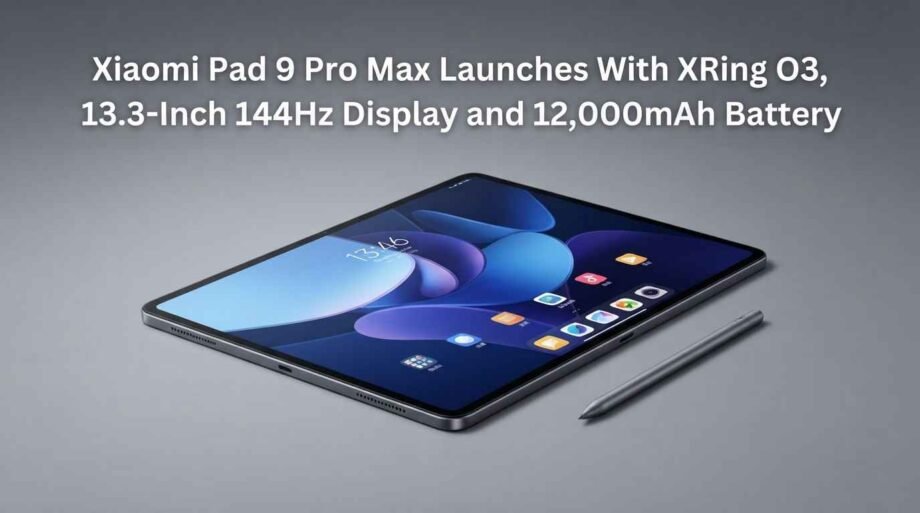
Xiaomi has launched Pad 9 Pro Max as its new flagship Android tablet in China. New tablet arrives alongside Xiaomi 18 Fold and use Xiaomi’s own XRing O3 processor. Xiaomi also bring a 13.3-inch display, up to 16GB RAM, up to 1TB storage, a 12,000mAh battery and 120W wired charging.
XRing O3 also mark a major step for Xiaomi in chip design. Early Geekbench testing show strong CPU performance, with chip reaching around 3,500 points in single-core testing and more than 13,000 points in multi-core testing. Results put XRing O3 ahead of current flagship Snapdragon hardware in some multi-core workloads.
Pad 9 Pro Max also focus on large-screen work. Xiaomi add HyperOS 4 based on Android 17, support for split-screen use, a file manager, document reader and browser. Users can open up to six apps at once, giving tablet a PC-style workflow.
Xiaomi Pad 9 Pro Max Processor
Xiaomi Pad 9 Pro Max use XRing O3, a processor developed by Xiaomi. Chip use a 10-core CPU design with two high-performance cores clocked at up to 4.36GHz. Four more cores run at 3.69GHz, while four power-efficient cores run at 3.15GHz.
Graphics processing come from Mali-G2-Ultra-NX MC16. TSMC manufacture XRing O3 using a 3nm process. Smaller chip process can help Xiaomi improve performance and power control.
Geekbench testing of a Xiaomi tablet with model number M367FC show around 3,500 points in single-core testing and more than 13,000 points in multi-core testing. Test unit include 16GB RAM and Android 17.
Multi-core performance stand out in early testing. Reported results show Pad 9 Pro Max perform more than 30% ahead of Lenovo Legion Tab Gen 5 with Snapdragon 8 Elite Gen 5 in multi-threaded testing.
Xiaomi also claim a major gain over previous XRing O1 hardware. Company report 54% higher multi-core performance and 85% higher GPU performance compared with devices using XRing O1. Xiaomi also claim up to 64% lower power consumption.
Performance figures can vary based on software, test conditions and device configuration, but results show Xiaomi aim XRing O3 at flagship-level performance.
13.3-Inch Display With 144Hz Refresh Rate
Pad 9 Pro Max feature a 13.3-inch LCD display. Screen use a 3408 x 2272 pixel resolution and a 3:2 aspect ratio.
A 3:2 screen provide more vertical space than a common 16:9 panel. Such a format can help with documents, web browsing, office work and split-screen tasks.
Display support a 144Hz refresh rate. Higher refresh rate can make scrolling, animation and supported games feel smoother.
Peak brightness reach 1,000 nits. Xiaomi also focus on large-screen productivity through HyperOS 4 software.
Screen size make Pad 9 Pro Max suitable for users who want a tablet for media, work and multitasking. Large panel also give more room for a keyboard and stylus setup.
HyperOS 4 and Android 17
Pad 9 Pro Max run Android 17 with Xiaomi HyperOS 4. Software bring features aimed at tablet productivity.
Users can open up to six apps through split-screen multitasking. Such a setup can help users keep a browser, document, file manager and other apps active during work.
Xiaomi also improve file management, document reading and browser functions. These changes aim to make tablet use closer to a desktop workflow.
Large screen, keyboard support and stylus support further expand possible use cases. Xiaomi offer a matching keyboard accessory with a pressure-sensitive touchpad. Company also offer Xiaomi Focus Stylus Pro for writing and drawing.
RAM and Storage Options
Xiaomi offer Pad 9 Pro Max in several memory and storage configurations.
RAM options include 8GB, 12GB and 16GB. Storage options include 256GB, 512GB and 1TB.
16GB RAM with 1TB storage provide highest capacity option for users who need more local storage. Lower configurations target users who want a lower starting price.
Available configurations include:
- 8GB RAM + 256GB storage
- 12GB RAM + 256GB storage
- 16GB RAM + 256GB storage
- 12GB RAM + 512GB storage
- 16GB RAM + 512GB storage
- 16GB RAM + 512GB Matte Glass
- 16GB RAM + 1TB Matte Glass
Memory and storage availability can vary by version and market.
50MP Rear Camera With OIS
Pad 9 Pro Max feature a 50MP rear camera with optical image stabilization. OIS can help reduce camera movement during photo and video capture.
Rear camera support 4K video recording at 60 frames per second. Such video support give users an option to record high-resolution footage at a higher frame rate.
For selfies and video calls, tablet include a 32MP front camera. Large display can also make video calls easier to manage, especially during work sessions.
Camera hardware does not appear to be primary focus of Pad 9 Pro Max. Xiaomi instead place more focus on display, processing power, battery and productivity.
12,000mAh Battery and 120W Charging
Pad 9 Pro Max carry a 12,000mAh battery. Xiaomi support 120W wired fast charging.
Large battery capacity can help support long work sessions, video playback, browsing and gaming. 120W charging also allow users to refill battery at a high charging rate when compatible charging hardware is used.
Tablet also support 27W reverse wired charging. A second reverse charging option provide 45W pogo pin reverse charging.
Reverse charging can allow tablet to provide power to compatible accessories or other devices. Pogo pin charging also connect with supported accessories without relying only on a USB cable.
Battery capacity and charging support place Pad 9 Pro Max among high-capacity Android tablets.
Eight Speakers and Six Microphones
Xiaomi add eight speakers to Pad 9 Pro Max. Speakers support Dolby Atmos for supported audio content.
Eight-speaker hardware can provide a wider audio setup for movies, music, games and video calls. Dolby Atmos support can also improve spatial audio on supported content.
Tablet include six microphones. Xiaomi design microphone system for 360-degree sound pickup.
Multiple microphones can help during video calls, meetings and voice recording. Combination of eight speakers and six microphones make audio another focus of Pad 9 Pro Max.
Thin and Light Design
Despite a 12,000mAh battery and large display, Pad 9 Pro Max measure 296.2 x 203.08 x 5.67mm.
Standard version weigh 645g. Matte Glass version weigh 653g.
At 5.67mm thick, tablet maintain a thin body while carrying a large battery and 13.3-inch screen. Xiaomi offer three color options: Rich Burgundy, Silver and Black.
A color-matched keyboard accessory is also available. Keyboard include a pressure-sensitive touchpad and work with tablet software for a laptop-style setup.
Xiaomi Pad 9 Pro Max Price in China
Xiaomi set starting price at CNY 4,799 for 8GB RAM and 256GB storage. Price convert to around $715 based on figures provided by launch reports.
Other configurations carry higher prices.
| Configuration | China Price |
|---|---|
| 8GB + 256GB | CNY 4,799 |
| 12GB + 256GB | CNY 5,299 |
| 16GB + 256GB | CNY 5,799 |
| 12GB + 512GB | CNY 6,099 |
| 16GB + 512GB | CNY 6,599 |
| 16GB + 512GB Matte Glass | CNY 6,899 |
| 16GB + 1TB Matte Glass | CNY 7,899 |
Prices convert to about $715, $789, $864, $908, $983, $1,027 and $1,176 respectively based on reported launch conversions.
Xiaomi has not confirmed international availability for Pad 9 Pro Max. Current launch information focus on China.
Xiaomi Pad 9 Series
Pad 9 Pro Max join Xiaomi’s new Pad 9 tablet lineup. Company also plan Pad 9 and Pad 9 Pro.
Pad 9 reportedly feature an 11.2-inch display, while Pad 9 Pro use a 12.5-inch screen. Pad 9 Pro Max sit at top of lineup with a 13.3-inch panel.
All three models are expected to debut during September in China.
Positioning Pro Max model at top of lineup allow Xiaomi to target users who want a large tablet with high-end processing and productivity features.
XRing O3 Also Power Xiaomi 18 Fold
XRing O3 is not limited to Pad 9 Pro Max. Xiaomi also confirm use of same processor in Xiaomi 18 Fold.
Xiaomi 18 Fold is expected to use LPDDR6 RAM supplied by CXMT. Pairing XRing O3 with newer memory technology show Xiaomi’s wider push toward in-house hardware development.
Xiaomi previously introduce XRing O1, while XRing O3 now target higher performance. Geekbench results and Xiaomi’s own performance claims suggest company aim to compete with flagship mobile processors from Qualcomm and other chip makers.
Xiaomi Pad 9 Pro Max Full Specifications
| Specification | Xiaomi Pad 9 Pro Max |
|---|---|
| Display | 13.3-inch LCD |
| Resolution | 3408 x 2272 pixels |
| Aspect Ratio | 3:2 |
| Refresh Rate | 144Hz |
| Peak Brightness | 1,000 nits |
| Processor | Xiaomi XRing O3 |
| CPU | 10-core |
| High-Performance Cores | 2 x 4.36GHz |
| Performance Cores | 4 x 3.69GHz |
| Efficiency Cores | 4 x 3.15GHz |
| GPU | Mali-G2-Ultra-NX MC16 |
| Chip Process | 3nm |
| RAM | 8GB / 12GB / 16GB |
| Storage | 256GB / 512GB / 1TB |
| Rear Camera | 50MP |
| Rear Camera Stabilization | OIS |
| Rear Video | Up to 4K at 60fps |
| Front Camera | 32MP |
| Speakers | 8 |
| Audio | Dolby Atmos |
| Microphones | 6 |
| Battery | 12,000mAh |
| Wired Charging | 120W |
| Reverse Wired Charging | 27W |
| Reverse Pogo Charging | 45W |
| Operating System | Android 17 |
| User Interface | HyperOS 4 |
| Dimensions | 296.2 x 203.08 x 5.67mm |
| Weight | 645g |
| Matte Glass Weight | 653g |
| Colors | Rich Burgundy, Silver, Black |
| Keyboard | Supported |
| Stylus | Xiaomi Focus Stylus Pro |
| Starting Price | CNY 4,799 |
| Launch Market | China |
Final Verdict
Xiaomi Pad 9 Pro Max bring a combination of large display, XRing O3 processing, high memory capacity, large battery and fast charging. 13.3-inch 3408 x 2272 LCD screen with 144Hz refresh rate and 1,000-nit peak brightness target both media and productivity users.
XRing O3 is main hardware highlight. Early Geekbench results show around 3,500 single-core points and more than 13,000 multi-core points. Xiaomi also report higher CPU and GPU performance compared with XRing O1, along with lower power consumption.
12,000mAh battery, 120W charging, eight speakers, six microphones, 50MP rear camera and 32MP front camera complete hardware package.
HyperOS 4 adds support for up to six apps in split-screen mode, while keyboard and stylus accessories make tablet suitable for work and creative tasks.
With a CNY 4,799 starting price in China, Pad 9 Pro Max target users who want flagship tablet hardware without moving to a laptop. International availability remains unconfirmed, so users outside China need to wait for Xiaomi to announce plans for other markets.
