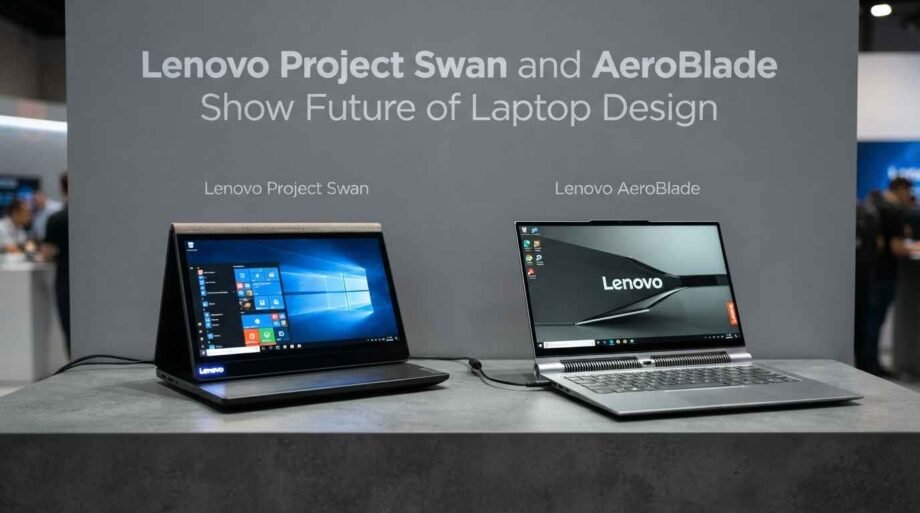
Lenovo showed two new laptop concepts at IFA 2026 in Berlin. Project Swan brings a rollable screen that can expand from 14 inches to 17 inches. Project AeroBlade uses AirJet cooling technology from Frore Systems to remove heat without a normal laptop fan.
Both concepts focus on laptop design. Project Swan aims to give users more screen space without making a laptop much larger. Project AeroBlade aims to make a laptop thinner, lighter and quieter.
Lenovo Project Swan Expands From 14 to 17 Inches
Project Swan is a productivity laptop with a rollable screen. A button lets users expand its display from 14 inches to 17 inches in a few seconds.
Lenovo uses a horizontal rolling system for Project Swan. When the screen stays closed, laptop keeps a 14-inch display. When a user needs more space, screen expands to 17 inches.
Extra screen space can help users who work without a second monitor. During a demo, a PDF could stay on one side while a Word document stayed on another side. This setup can make multitasking easier.
Project Swan also keeps a normal laptop design when its screen stays closed. Lenovo includes a large touchpad, keyboard, webcam and speakers. Laptop has two USB-C ports.
Project Swan measures 17.9mm in thickness and weighs 3.5 pounds. Lenovo designed concept for people who need more screen space while traveling.
A small ripple can appear on screen where display expands. Lenovo has not shared a retail release plan for Project Swan.
Project AeroBlade Uses AirJet Cooling
Project AeroBlade takes a different approach. Lenovo uses AirJet cooling from Frore Systems instead of a standard laptop fan.
Traditional laptop fans move air to help remove heat from CPU. AirJet uses tiny modules with ultrasonic vibration to move air through laptop.
Lenovo calls its system Active Flow Thermal Solution. AirJet modules pull air from inside laptop and create high air pressure. Air then moves across a copper base layer through small jets. This process helps remove heat from processor.
AeroBlade has four AirJet modules placed near top of motherboard. Frore says each module can create much more back pressure than a normal laptop fan.
AirJet can also reduce need for large vents. Lenovo says system uses similar power to a normal fan and offers resistance against dust and water.
AeroBlade Measures 10mm and Weighs 1.8 Pounds
One of biggest points of Project AeroBlade is its size. Laptop measures only 10mm thick and weighs 1.8 pounds.
Lenovo uses a magnesium-aluminum body. Concept also has an OLED display, USB-C ports with Thunderbolt 4 support and Wi-Fi 7.
Despite its small size, AeroBlade was shown as a working laptop rather than a simple display model. Lenovo said sample had stable operation during demo.
Engineering sample uses an Intel Lunar Lake processor. Cooling system supports up to 20 watts of thermal design power. Frore also has a more powerful AirJet Pro version for systems that need more cooling.
Lenovo has not confirmed which processor will appear if AeroBlade reaches production.
AirJet Could Change Laptop Cooling
AirJet uses a piezoelectric membrane that vibrates to create airflow. Unlike a normal fan, system has no spinning blades.
This design can reduce noise and may also reduce dust entering laptop. With fewer moving parts, AirJet may also offer another path for laptop makers that want thinner designs.
AeroBlade also uses less space for cooling hardware. Space saved inside laptop could allow manufacturers to add a larger battery or other components.
Lenovo is first computer maker to show a laptop with Frore AirJet Mini technology. Partnership is not exclusive, so other laptop brands may also use AirJet in future devices.
However, Lenovo has not shared price, battery life or release date for AeroBlade. Cost of AirJet may also affect whether technology appears in regular consumer laptops.
Lenovo Shows More Concept Technology at IFA 2026
Project Swan and Project AeroBlade were part of Lenovo’s wider IFA 2026 display.
Lenovo also showed ThinkVision monitors, ThinkCentre desktop PCs and new ThinkBook laptops.
ThinkVision P27UL-40 uses inkjet-printed OLED technology. Monitor has a 27-inch display with 3,840 × 2,160 resolution and up to 120Hz refresh rate. Lenovo plans to release monitor in March 2027 with a starting price of $1,300.
ThinkCentre X Ultra uses an AMD Ryzen AI Max Plus Pro 495 processor, integrated graphics, up to 128GB RAM and up to 8TB storage. Lenovo plans to release desktop in November with a starting price of $3,700.
Lenovo also showed ThinkBook 14 Gen 9 and ThinkBook 14x Gen 2. ThinkBook 14 Gen 9 uses a Snapdragon X2 Plus processor and supports up to 32GB RAM and 1TB storage. ThinkBook 14x Gen 2 uses Intel Core 7 Series 3 and supports up to 32GB memory and 2TB storage.
Project Swan and AeroBlade Show Different Laptop Ideas
Project Swan and Project AeroBlade solve different laptop problems.
Project Swan focuses on screen space. A 14-inch laptop can become a 17-inch display when users need more room for work or entertainment.
Project AeroBlade focuses on cooling. AirJet technology removes heat without using a normal fan, allowing Lenovo to build a 10mm laptop that weighs 1.8 pounds.
Neither concept has a confirmed retail launch. Still, both show how Lenovo is testing new ways to design laptops.
Project Swan could help make large-screen laptops easier to carry. Project AeroBlade could help laptop makers build thinner systems with new cooling methods.
For now, Lenovo has not confirmed when either concept will reach stores. IFA 2026 gives users a look at two possible directions for future laptop design.
