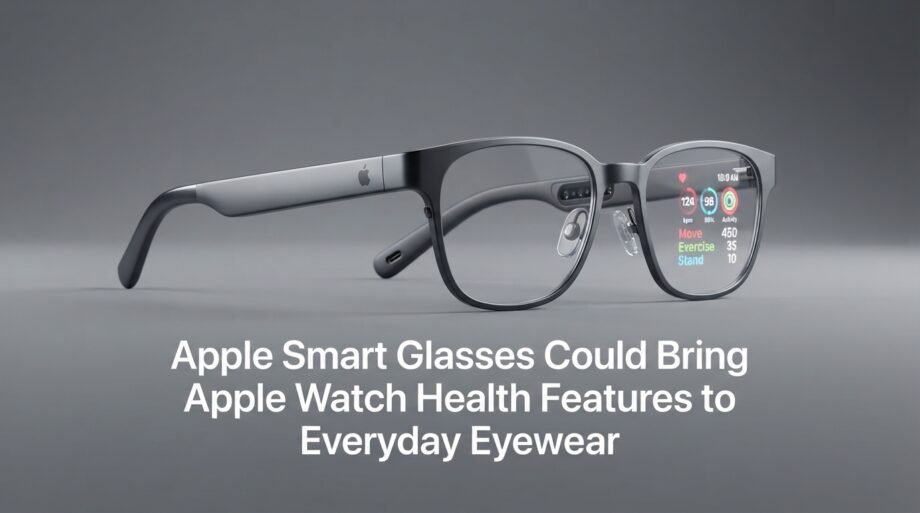
Apple is working on smart glasses that could become a new part of its wearable product line. Reports point to a device that can pair with an iPhone, use a camera, speaker and microphone, and support AI features. Apple may also bring health and fitness functions from Apple Watch to future versions.
Apple has not confirm launch date, price or full specifications. Current reports point to a possible launch near end of 2027. First-generation glasses may focus on AI, camera functions, audio, translation and navigation. Health and fitness functions may come later.
Apple Smart Glasses Development
Apple already has experience with wearable technology through Apple Watch and Vision Pro. Apple Watch started as a device for fitness and later gain health functions such as heart rate tracking, fall detection, blood oxygen monitoring and heart rhythm alerts in supported markets and models.
Vision Pro showed Apple interest in spatial computing and wearable devices. However, Vision Pro has a high weight for long fitness use. Reports say Apple had consider using Vision Pro for exercise, with sensors able to track body movement and display health data such as heart rate and calories.
Weight creates a problem for a fitness headset. Apple may now focus on glasses with a form closer to normal eyewear. A lighter design can support longer daily use and may create more options for health and fitness functions.
Apple Smart Glasses May Rival Meta Ray-Ban
Smart glasses have become a growing product category. Meta has built a market with Ray-Ban Meta glasses. Meta has also add prescription models, giving users another way to use camera, speaker, microphone and AI functions while wearing normal eyewear.
Google is also working on AI smart glasses with eyewear partners such as Warby Parker and Gentle Monster. Apple may enter same market with its own frame design and hardware.
Apple reportedly plans to develop glasses in-house instead of using an eyewear partner. Reports mention four frame designs under testing. Designs include rectangular frames and oval or circular frames.
Frames may use acetate. Apple may also place cameras in a vertical oval design with indicator lights around camera area.
Expected Apple Smart Glasses Features
First-generation Apple smart glasses may not include full AR visuals. Instead, reports point to a camera, speaker and microphone connected to an iPhone through Bluetooth.
Possible functions include:
- Object recognition
- Live translation
- Audio navigation
- Voice commands
- Notification display
- Camera functions
- AI assistance
- Siri interaction
- Audio response
- iPhone connection
Visual Intelligence may help glasses identify objects and provide information through audio. Live translation may help users understand speech in another language. Turn-by-turn directions may provide audio guidance during travel.
A notification display may also appear in some form. Reports suggest first-generation glasses may not use a full AR screen. This approach can reduce power use and hardware requirements.
Siri may play a major role in controlling glasses. Apple can use voice input through microphone and send requests to iPhone or cloud-based services.
Apple Watch Technology May Enter Smart Glasses
Health and fitness may become a major part of Apple smart glasses in future versions.
A recent Apple job listing points toward work on health, wellness and fitness features for augmented reality products. Job responsibilities include finding use cases and turning ideas into product functions.
Reports suggest first-generation glasses may not include health and fitness features. Apple may wait for a later generation before adding functions that require more sensors and processing.
Apple Watch can already track several health and fitness metrics. Some functions depend on model, region and regulatory approval. Moving similar functions to glasses could give Apple another way to collect health data during daily activity.
Glasses have a position that can offer access to areas around eyes, temples and head. Future devices may use sensors for eye movement, pupil response, temperature, heart-related signals, muscle activity and other body data. Many of these functions remain research areas and should not be treated as confirmed Apple features.
Smart Glasses and Vision Support
Smart glasses can also support people with vision impairment. Camera and AI systems can read text, identify objects and describe surroundings through audio.
Vision impairment affects billions of people worldwide. Access to glasses and eye care also remains limited in many low-income regions. Smart eyewear cannot replace medical care, but camera and AI functions can support daily tasks.
Some existing products already focus on vision assistance. Devices from companies such as eSight and Envision use cameras, displays or AI functions to support people with low vision.
Future Apple glasses could use camera-based recognition for daily activities. A user may ask Siri to identify an object, read text or provide directions. Such functions could also support people who need help with daily navigation.
Smart Glasses for Migraine and Light Sensitivity
Wearable eyewear also has a role in light sensitivity and migraine management. Some glasses use lens filters to reduce exposure to light frequencies linked with discomfort.
Avulux, for example, offers glasses designed for migraine and light sensitivity. Some products focus on filtering selected wavelengths while keeping color perception.
Future smart glasses may combine lens technology with sensors and software. A device could detect light conditions and adjust settings based on user needs. AI-based lens control remains a possible future direction rather than a confirmed Apple function.
Apple Smart Glasses Processor
Apple may use a modified version of an Apple Watch S-series processor inside smart glasses. A processor based on Apple Watch technology could focus on power efficiency while handling camera and AI tasks.
Power use remains a key issue for smart glasses. A small frame cannot carry a battery similar to a phone or headset. Apple needs to balance processor power, camera use, AI processing, Bluetooth connection and battery life.
Using iPhone for some processing can reduce hardware requirements inside glasses. This approach may also allow Apple to keep frame size close to normal eyewear.
Why Apple May Avoid Full AR in First Generation
Full AR requires displays, sensors, graphics processing and battery capacity. Such hardware can increase weight and cost.
Apple may avoid full AR visuals in first generation. Instead, Apple may focus on audio, camera, AI and notifications.
This approach can also match how Meta Ray-Ban glasses work. Users can wear glasses during normal daily activity without dealing with a large headset.
Apple can later add more hardware after learning how users interact with smart glasses.
Apple Smart Glasses Launch Date
Apple has not announce an official launch date. Earlier reports point to 2027, while newer reports suggest development delays may push launch toward end of 2027.
WWDC 2027 could become one possible event for an announcement, but Apple has not confirm any event or product schedule.
Development can also change before launch. Hardware, battery, AI performance, privacy requirements and software support can affect release timing.
Apple Smart Glasses Price
Apple has not announce a price for smart glasses.
Meta Ray-Ban and Oakley smart glasses currently sit around a $299 to $499 range, depending on model and configuration. Apple may use a similar range or choose a higher price based on hardware and services.
Without an official announcement, any Apple smart glasses price remains an estimate.
Privacy Will Matter for Camera Glasses
Camera-based eyewear creates privacy questions. Smart glasses can capture photos, video and audio while users move through public places.
Apple may need clear camera indicators, user controls and privacy settings. Indicator lights around camera areas have reportedly appeared in Apple prototype designs.
Privacy can become a major factor in adoption. Users need to know when camera functions are active and how captured data is handled.
What Apple Smart Glasses Could Become
Apple smart glasses may start as an iPhone accessory with AI, camera, audio and notification functions. Future versions could add health, fitness and vision support.
Apple Watch provides a useful example of how Apple can turn wearable hardware into a health platform. Apple smart glasses may follow a similar path.
First generation may focus on basic smart functions. Later versions may add sensors for fitness, health and vision. AI can connect these functions through Siri and Apple Intelligence services.
Smart glasses also offer a different position from a smartwatch. A watch sits on wrist and can measure activity from arm movement. Glasses sit near eyes, temples and head, creating access to different signals.
For Apple, this creates a new hardware category between iPhone and Apple Watch. For users, smart glasses may provide information without requiring a phone screen.
Conclusion
Apple smart glasses could become a major part of Apple wearable plans. Current reports point toward an iPhone-connected device with camera, microphone, speaker, AI, translation, object recognition, navigation and Siri support.
First generation may skip full AR and focus on functions that work with normal eyewear. Health and fitness features may come later, based on lessons from Apple Watch and work on Vision Pro.
Competition from Meta and Google is already pushing smart glasses forward. Apple may enter market with its own hardware, software and AI system.
If Apple can solve battery, privacy, weight and AI challenges, smart glasses could move from an iPhone accessory into a health, fitness and daily assistance platform.
Note: Apple has not officially confirm most reported specifications, health functions, price or launch timing. Features and plans may change before release.
