Samsung’s upcoming Galaxy A18 budget smartphone has appeared on Geekbench, giving an early look at its hardware, software, and expected performance. While the benchmark results suggest that Samsung is keeping some familiar components from the previous generation, the phone could make a notable jump in software by launching with Android 17 and One UI 9.
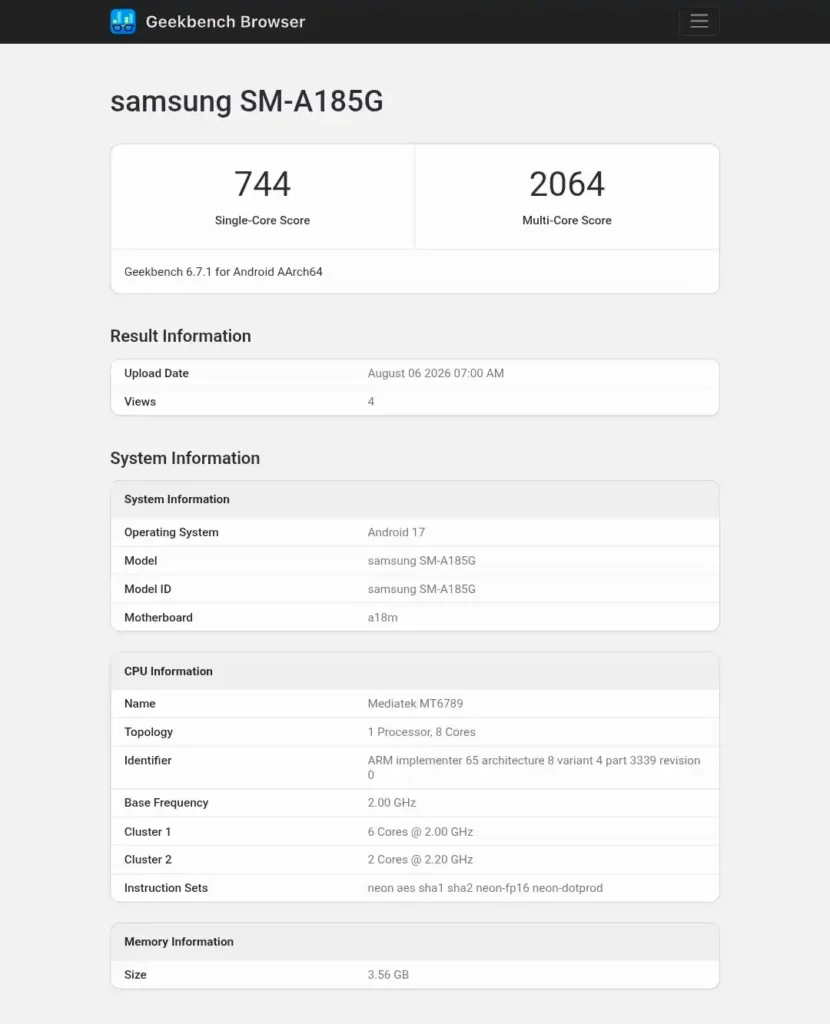
The Galaxy A18 4G was spotted in the Geekbench database under model number SM-A185G, while another variant, SM-A185F, has also been linked to Samsung’s European test firmware. The benchmark listing shows the device achieving roughly 744–745 points in single-core performance and around 2,064–2,073 points in multi-core testing.
Same Helio G99 Chip as the Galaxy A17
The biggest takeaway from the leak is that the Galaxy A18 4G appears to use MediaTek’s Helio G99 processor, the same chipset found in the Galaxy A17 4G.
The Helio G99 is a 6nm octa-core chip introduced by MediaTek in 2022. It features two Cortex-A76 performance cores clocked at up to 2.2GHz, six Cortex-A55 efficiency cores running at up to 2.0GHz, and a Mali-G57 MC2 GPU.
Samsung has already used the processor across several generations of its affordable Galaxy A-series phones, including the Galaxy A15 4G, Galaxy A16 4G, and Galaxy A17 4G. Its continued use in the Galaxy A18 suggests Samsung is prioritizing cost control over a major performance upgrade.
The phone is also listed with 4GB of RAM and 128GB of storage in its benchmark configuration. While 4GB of RAM is now considered limited for a modern smartphone, rising component costs and supply pressures may be encouraging manufacturers to continue using older memory configurations in entry-level devices.
Android 17 Could Be the Galaxy A18’s Biggest Upgrade
Although the hardware appears familiar, the software side of the Galaxy A18 is much more interesting.
The Geekbench test unit was running Android 17, reportedly with Samsung’s One UI 9 interface. If this software configuration remains unchanged for the retail model, the Galaxy A18 could launch directly with Samsung’s newest Android-based software rather than an older version.
That would give the phone an unusual combination: an aging entry-level processor paired with Samsung’s latest software platform.
The key question will be optimization. With only 4GB of RAM and the same Helio G99 processor used in the previous generation, Samsung will need to ensure that One UI 9 remains responsive on the relatively modest hardware.
For everyday tasks such as calls, messaging, web browsing and light social media use, the configuration should be adequate. However, demanding games, intensive multitasking and feature-heavy applications could expose the limitations of the older chipset and limited RAM.
Familiar Design Expected
The Galaxy A18 is also not expected to completely reinvent Samsung’s budget-phone design.
Leaked information points toward an Infinity-U/waterdrop-style notch on the front, while the rear is expected to feature a vertically arranged triple-camera system. Overall, the phone appears likely to retain the familiar design approach of the Galaxy A-series rather than introducing a dramatic visual change.
Details about the camera specifications, display, battery and other hardware remain limited at this stage.
5G Model Could Be More Interesting
Samsung is reportedly preparing both 4G and 5G versions of the Galaxy A18.
The 4G model is expected to arrive first, while the Galaxy A18 5G could follow several months later. Previous reports have suggested that Samsung may use a Qualcomm Snapdragon chipset in the 5G version, potentially giving it a more significant hardware difference from the A18 4G.
The timing of the 5G model may depend partly on Qualcomm’s chipset availability.
Production and Launch Timeline
Samsung has yet to officially announce the Galaxy A18, so its launch date remains unconfirmed. However, the company is reportedly preparing for mass production of the 4G version.
Leaked production plans suggest Samsung could produce around 100,000 units in August, 2.4 million in September and 2.5 million in October, although these figures could change depending on market conditions and demand.
If Samsung follows the release pattern of previous Galaxy A-series models, the Galaxy A18 4G could arrive around the third or fourth quarter, with the 5G version following later.
A Familiar Phone With New Software
The Galaxy A18 is shaping up to be an interesting but conservative upgrade. On the hardware side, Samsung appears ready to reuse the Helio G99 processor and 4GB RAM configuration from the previous generation, meaning buyers should not expect a major performance improvement.
At the same time, the potential move to Android 17 and One UI 9 could give the phone a more modern software experience than its hardware might suggest.
Ultimately, the Galaxy A18’s success may depend heavily on its price. If Samsung can keep the phone affordable while delivering smooth One UI 9 performance and strong long-term software support, the recycled hardware may be easier for budget buyers to accept. If the price rises significantly, however, the lack of a meaningful performance upgrade could become a major weakness.
For now, the Geekbench appearance provides one of the clearest early pictures of Samsung’s next entry-level Galaxy phone: familiar hardware, modern software, a largely familiar design, and a 5G model that could offer a more substantial upgrade later.
This version combines the benchmark results, processor/RAM details, Android 17 and One UI 9, design leaks, 4G/5G plans, production timeline, and performance expectations from all three articles into one unified story.
